USA
 Brazil
 China
 Croatia
 Europe
 France
 Germany
 Italy
 Japan
 Latin America
 Netherlands
 Spain
 Turkey


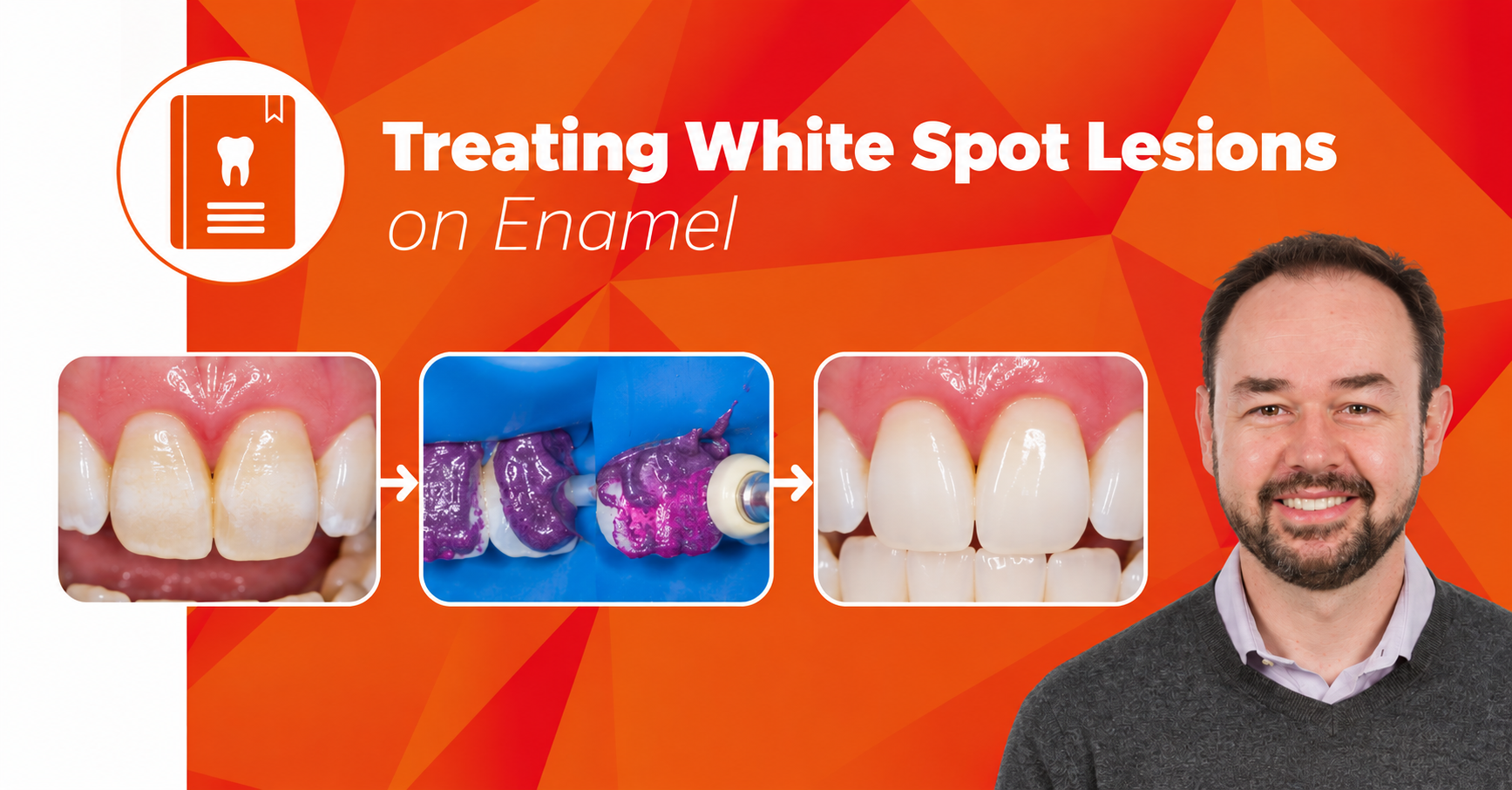


Article by Dr. Renato Palo

Enamel microabrasion treatment in one session with Opalustre, courtesy of Dr Rich Tuttle.
White spot lesions (WSLs) present clinically as areas of white opacity resulting from subsurface enamel demineralisation on smooth tooth surfaces. A range of developmental disturbances can disrupt normal enamel prism formation. Any disruption to a glassy or prismatic surface produces a white mark, much like a scratch on glass. These structural irregularities alter the way light reflects off the enamel surface, producing the characteristic white spot appearance. When improved oral hygiene and low-dose topical fluoride fail to resolve their appearance, clinicians have two further treatment options: tooth whitening and enamel microabrasion.
Balancing colour and translucency
When addressing any aesthetic alteration, I favour starting with the least invasive treatment and escalating only as needed. This sequencing reassures the patient and preserves the maximum amount of natural tooth structure. My preference is to begin with a whitening gel and evaluate the results before considering microabrasion. As the surrounding tooth structure lightens, white spots often become less perceptible and blend more naturally with the overall tooth shade.
It’s worth noting that even mild dehydration caused by the whitening process can temporarily make an existing white spot more visible. Patients sometimes worry that the whitening agent has caused or worsened the lesion, when in fact rehydration resolves this effect. For this reason, patients should be given adequate time with whitening before considering an alternative approach.
A harmonious, aesthetic smile depends on many factors, and patients benefit most when whitening is guided by a clinician who has developed strong aesthetic judgment. Tooth colour reflects the interplay of two tissues: dentine and enamel. Dentine is typically darker and enamel lighter; younger enamel appears milky while older enamel becomes more translucent, and dentine darkens with age. Overall tooth colour is ultimately determined by how light refracts and reflects across these structures.
When enamel microabrasion is indicated
If whitening alone does not achieve the desired outcome for certain WSLs, microabrasion becomes a reasonable next step. It removes a thin layer of the affected enamel prisms, restoring more typical light reflectance and surface appearance.
One product with a long track record in this space is Opalustre (Ultradent Products), a chemical-mechanical abrasive slurry indicated for removing superficial enamel imperfections, including mild fluorosis discoloration. It combines 6.6% hydrochloric acid for controlled chemical stain removal with silicon carbide microparticles for gentle mechanical abrasion, typically removing less than 0.2 mm of enamel in a single appointment. The technique is supported by an extensive body of literature, with published clinical cases spanning more than three decades.
A key advantage of this approach is that no resin or material is left on the tooth surface afterward. The treated enamel is simply refined, and because the discoloured layer is physically removed rather than masked, the stain does not recur. In cases where white spots extend deeper into the dentine, a conservative composite restoration may be the more appropriate solution, as the next step in the minimally invasive dentistry ladder.
Author

Dr Renato Palo is a graduate of the Paulista University in São Paulo, Brazil. He obtained his endodontics specialty in a postgraduate program at The University of São Paulo in Brazil. Dr Palo received his master’s degree from The State University of São Paulo (UNESP), where he also worked as a collaborating professor of endodontics. He obtained his PhD at the State University of São Paulo.
Dr Palo has worked as a part-time endodontist and part-time professor and presided over two postgraduate programs in Brazil. He has organised dental congresses, including as scientific coordinator of the CIOSP International Dental Congress.
Dr Palo has carried out in vitro and in vivo experiments and has worked as a developer and evaluator of dental materials. He has given more than 250 presentations in 66 countries.